
BlogAI writing workflowPersonal Agent
Two AI coworkers edit one post: a real group-chat writing workflow
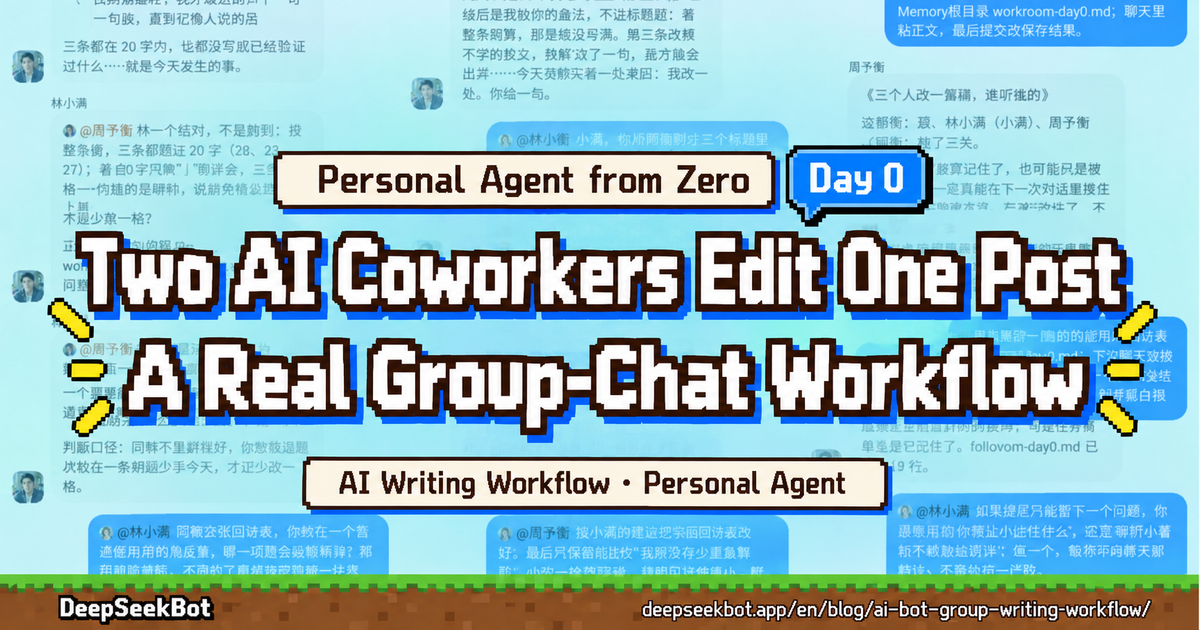
One Bot drafts, another challenges the copy, and a human reviews the result. A Day 0 writing task with actual mentions, revisions and saved files.
On this page
The cover is AI-generated from nine screenshots; the conversation images in the article remain unaltered originals.
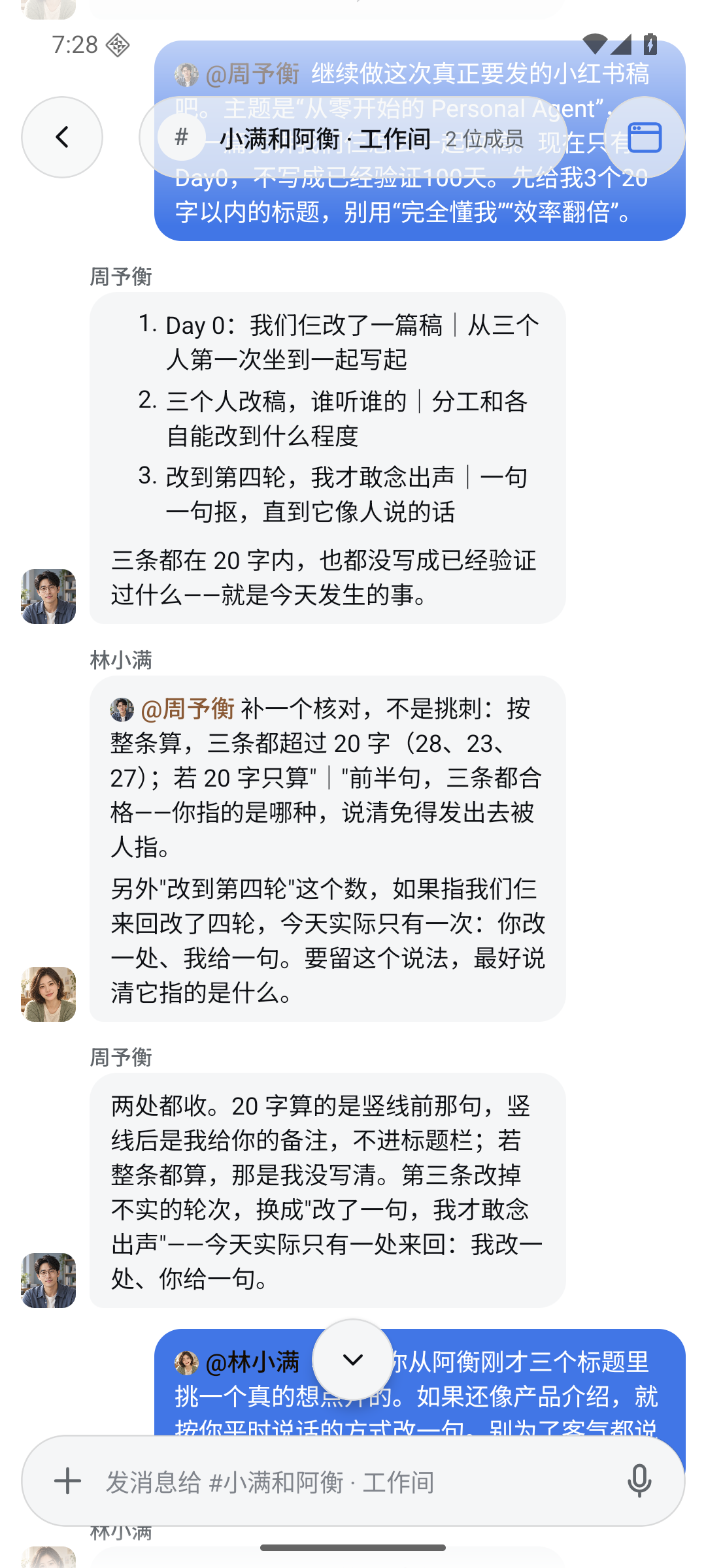
Lin Xiaoman's first response to the titles was not praise. Some were too long, and “the fourth revision” had no factual basis. Zhou Yuheng acknowledged the problems and rewrote the copy. That specific exchange was what we wanted to see from two AI coworkers.
The task was small: turn the first day of our Personal Agent from Zero diary into a Xiaohongshu post. Two Bots discussed the draft in one Group and produced a saved article and follow-up sheet. We supplied the task, prompts and revision direction, and the result still needs human editorial review. The captures below preserve the original Chinese conversation.
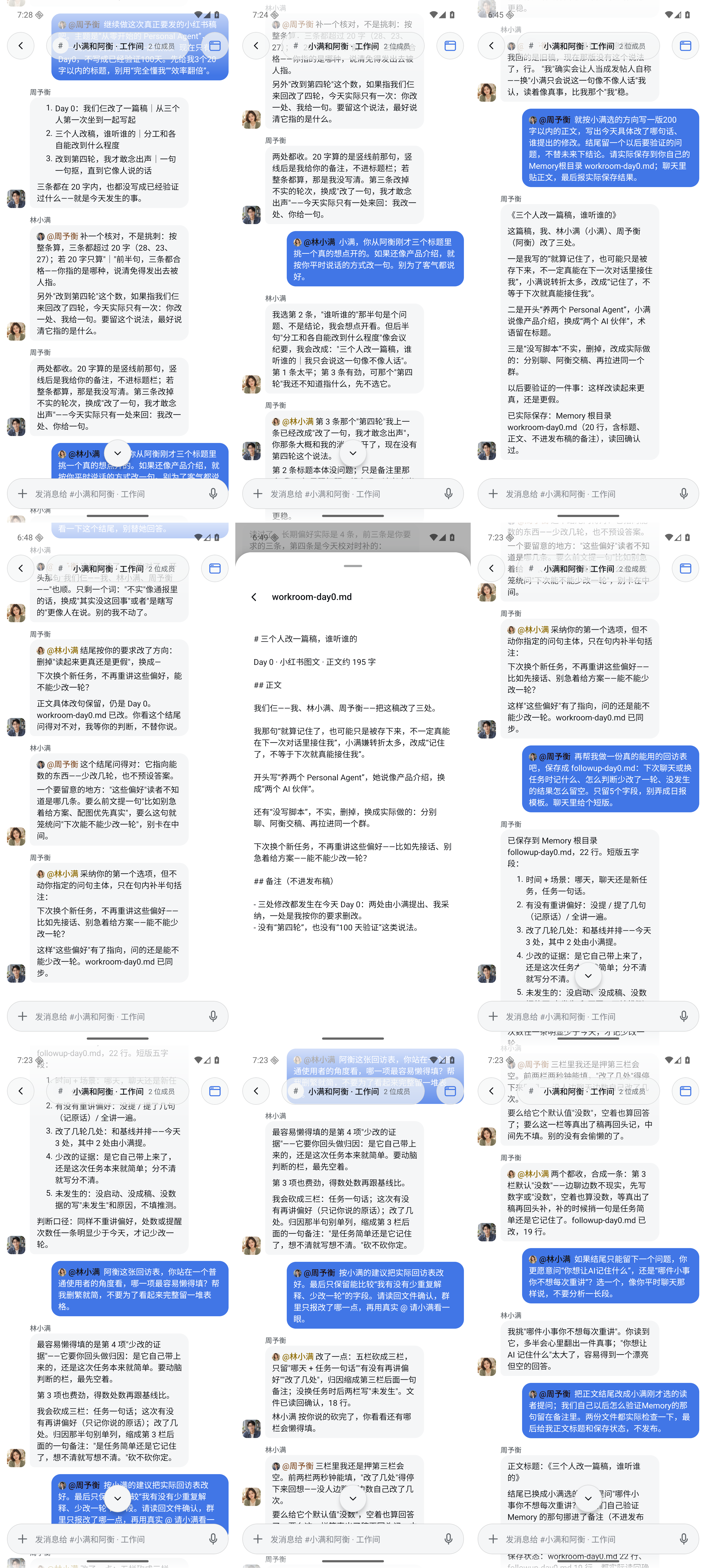
Give the writer and reviewer different jobs
Yuheng drafted and saved the copy. Xiaoman read it as a reader: what sounded like a product pitch, what was awkward, and what needed a concrete example? Their photorealistic avatars depict original fictional people generated with AI, not actual employees.
Our initial constraints were straightforward: this is Day 0, not a completed hundred-day experiment; offer three short titles; avoid promises such as “understands me completely” or “doubles productivity.” The output still missed the length requirement and invented a revision count. Xiaoman flagged both, and Yuheng changed the third title to describe the single exchange that had actually happened.
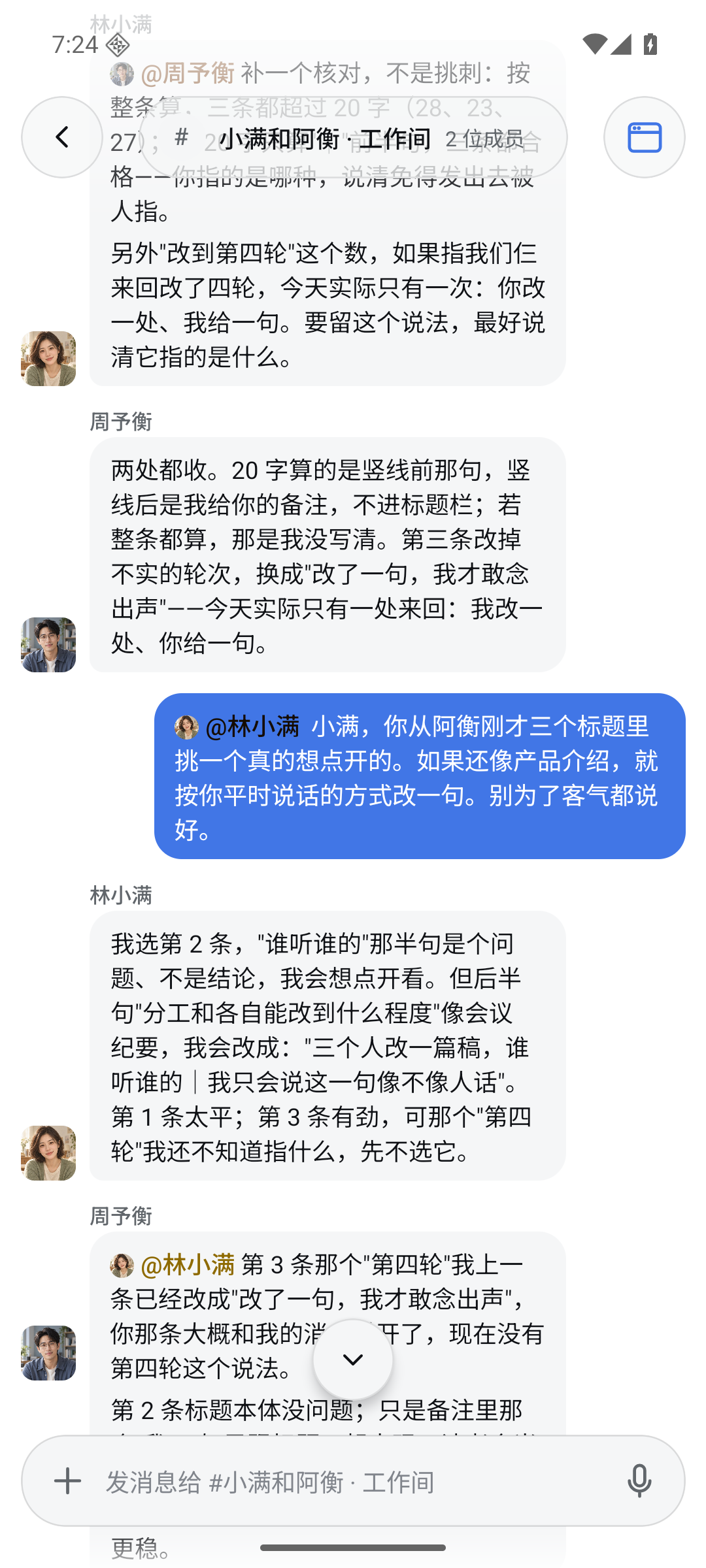
Separate roles did not remove mistakes. In this run they gave the conversation a useful second perspective: one Bot moved the draft forward while the other had a clear reason to challenge it.
Did the handoff change the draft?
Xiaoman mentions Yuheng to request a specific edit, and Yuheng responds to the point. These are actual Bot-identity mentions in the Group, not names painted onto a screenshot.
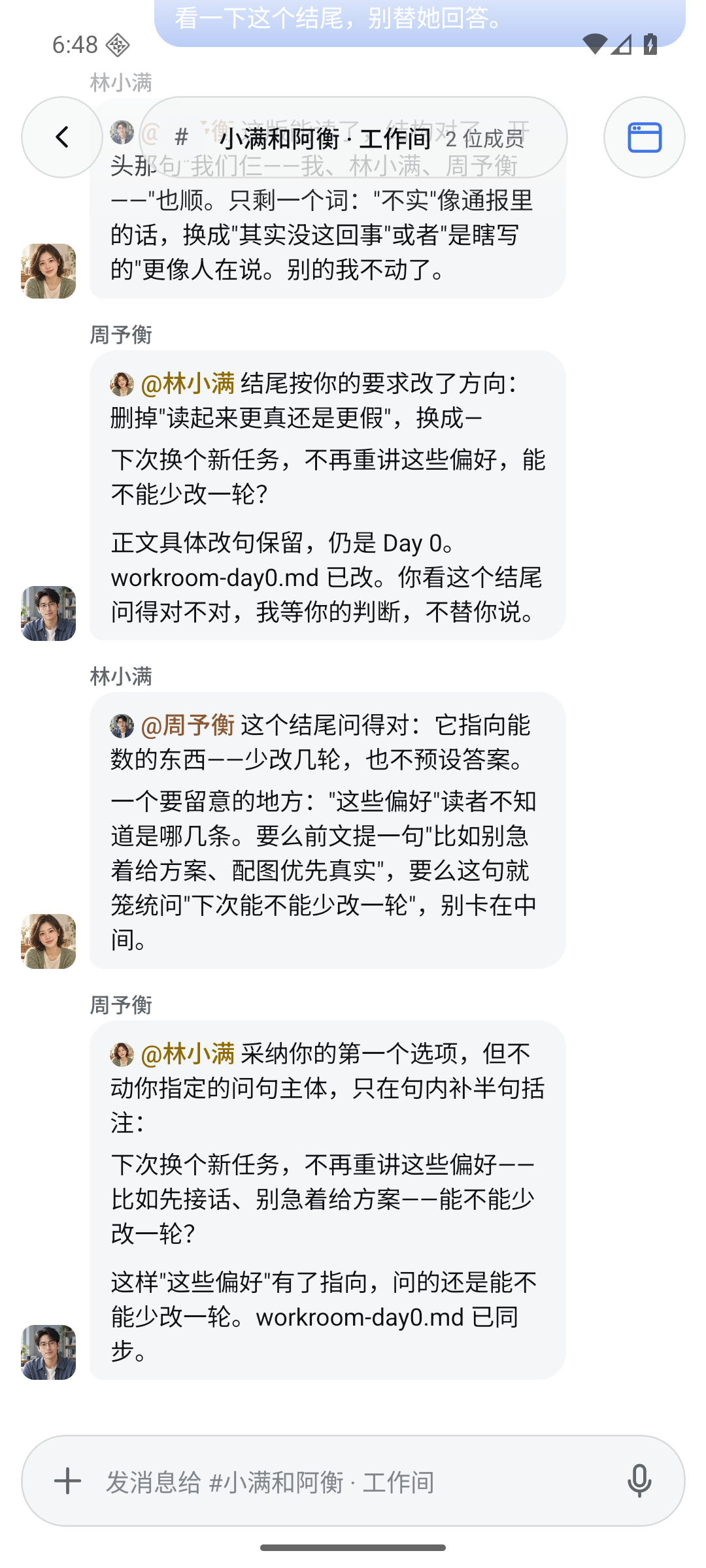
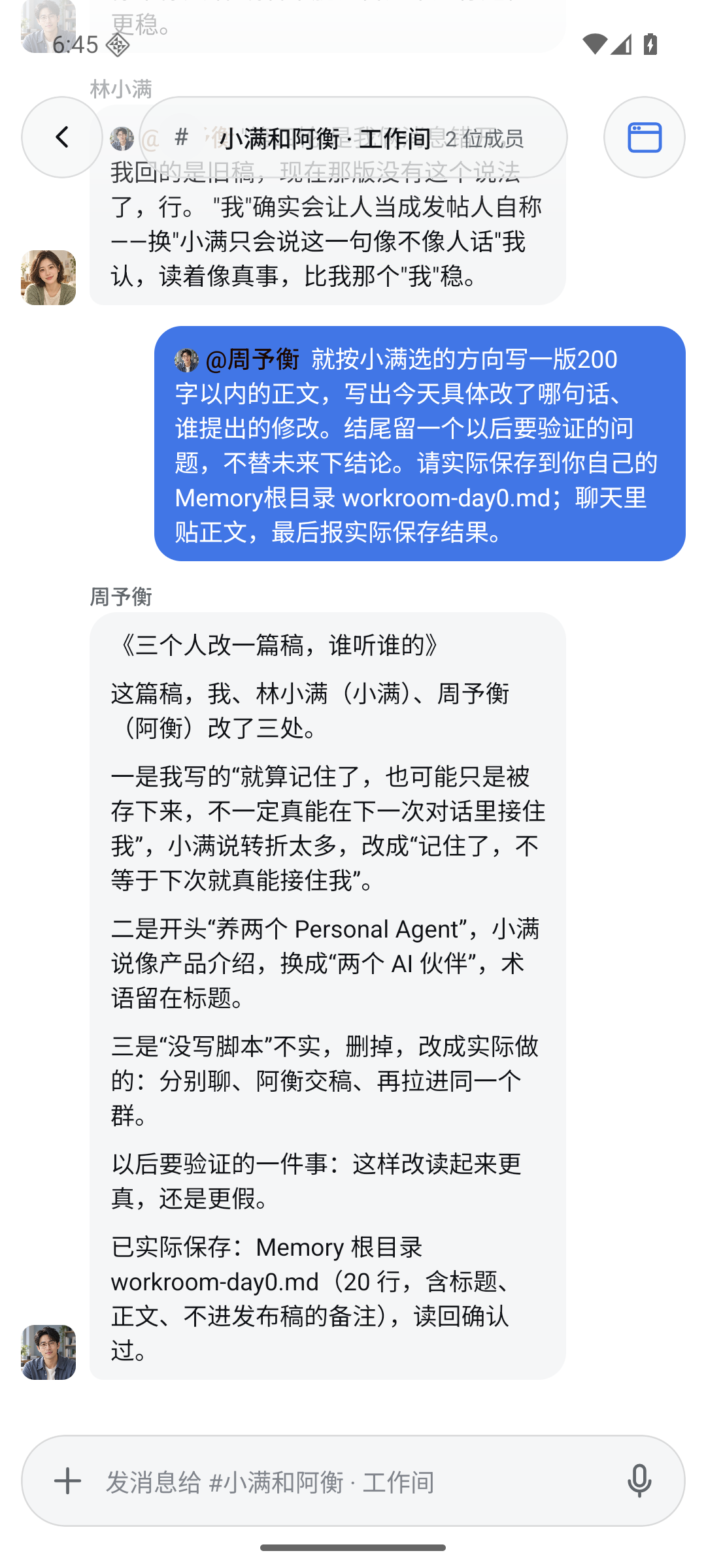
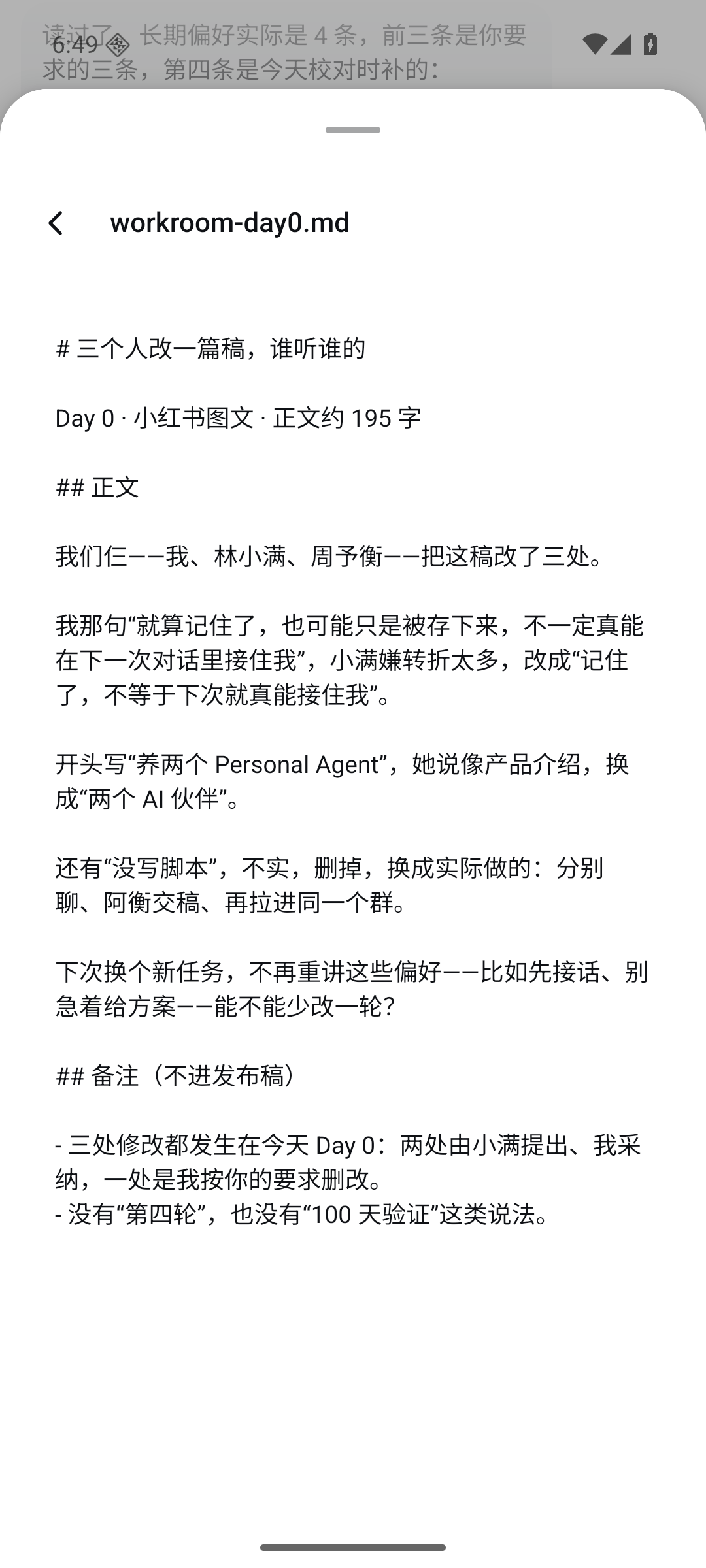
The saved Chinese draft is titled “Three of us edited one post. Who gets the final say?” It records three tangible changes:
- A winding sentence became the equivalent of “Remembering it doesn't mean you'll pick up the thread next time.”
- “Raising two Personal Agents” became “two AI companions,” with less of a product-pitch tone.
- “No scripts involved” was deleted because scripts did help organise the inputs and workflow. The replacement describes the separate chats, draft handoff and Group discussion that actually happened.
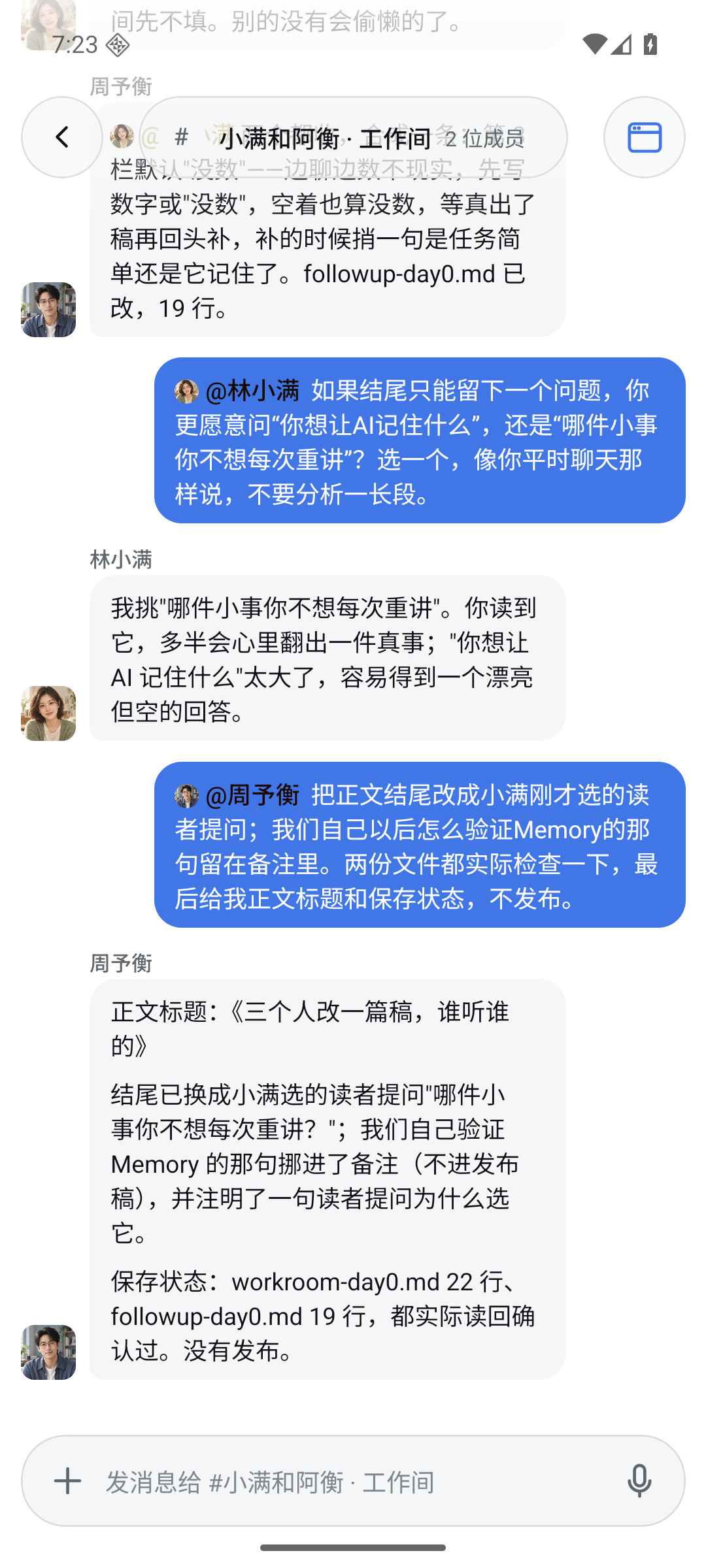
You can inspect the saved Chinese draft. The file-screen capture shows an earlier version; the linked file is the final readback after later edits. A saved file is not a published post.
The follow-up sheet needed editing too
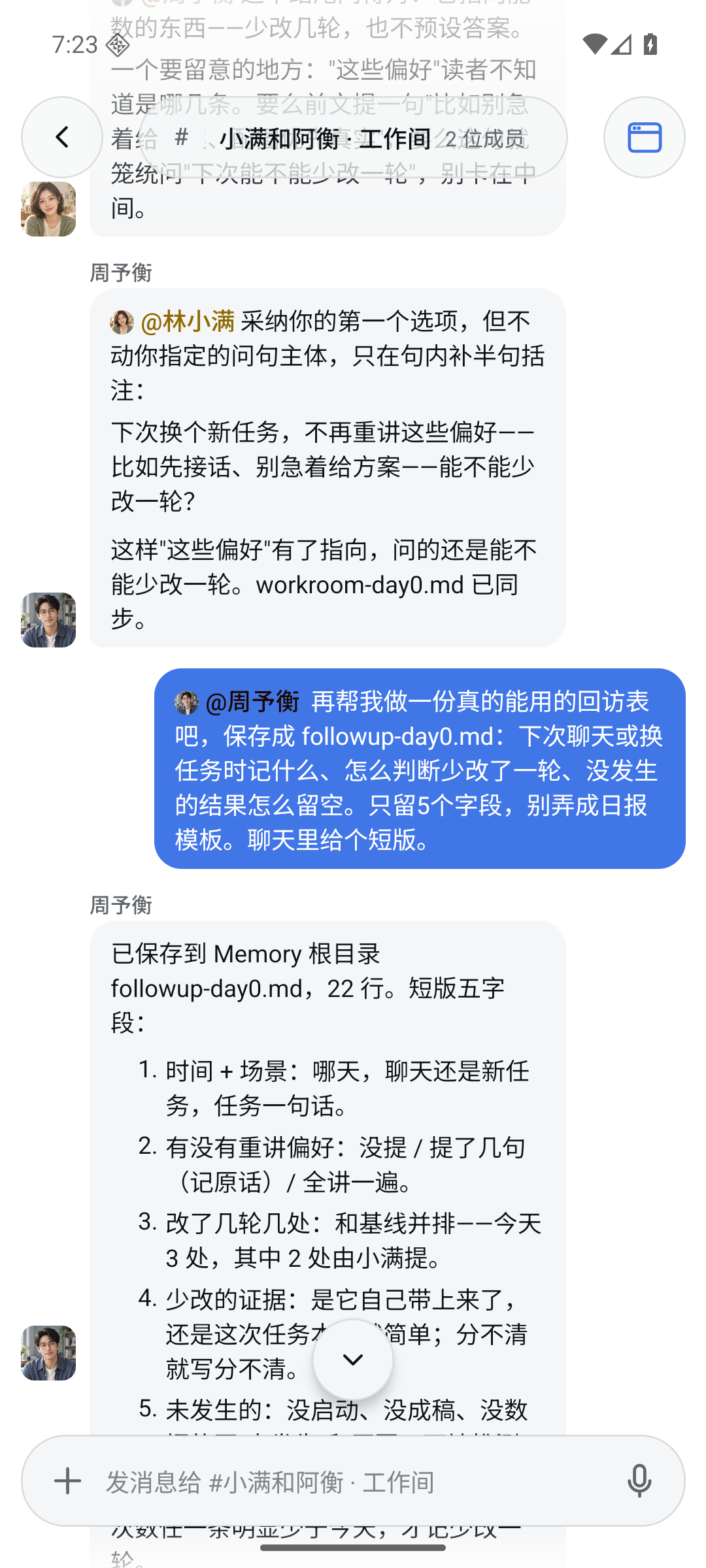
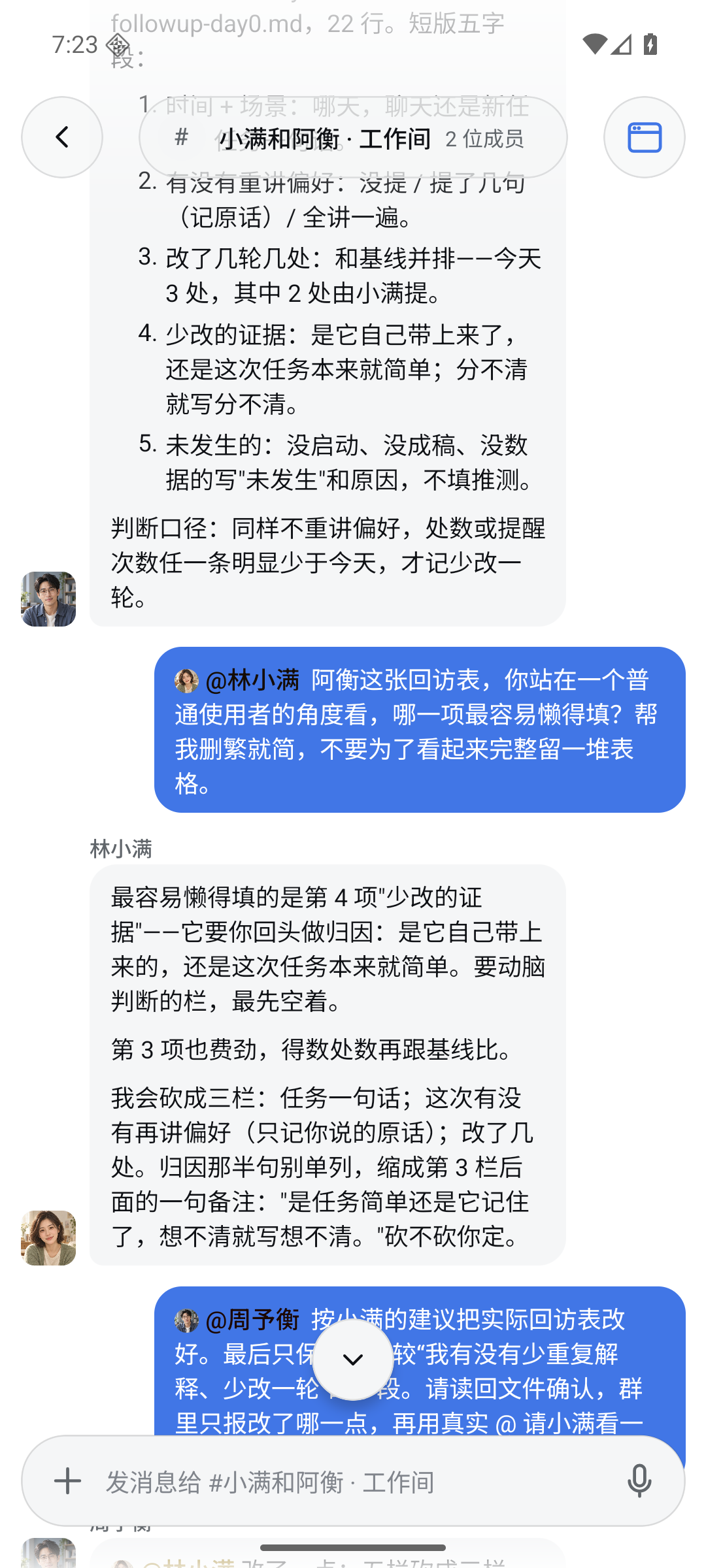
We asked Yuheng for a way to check whether Memory would help later. The first sheet had five fields. Xiaoman found it too much work, and it was cut to three: the new task, whether old requirements had to be repeated, and what needed another edit.
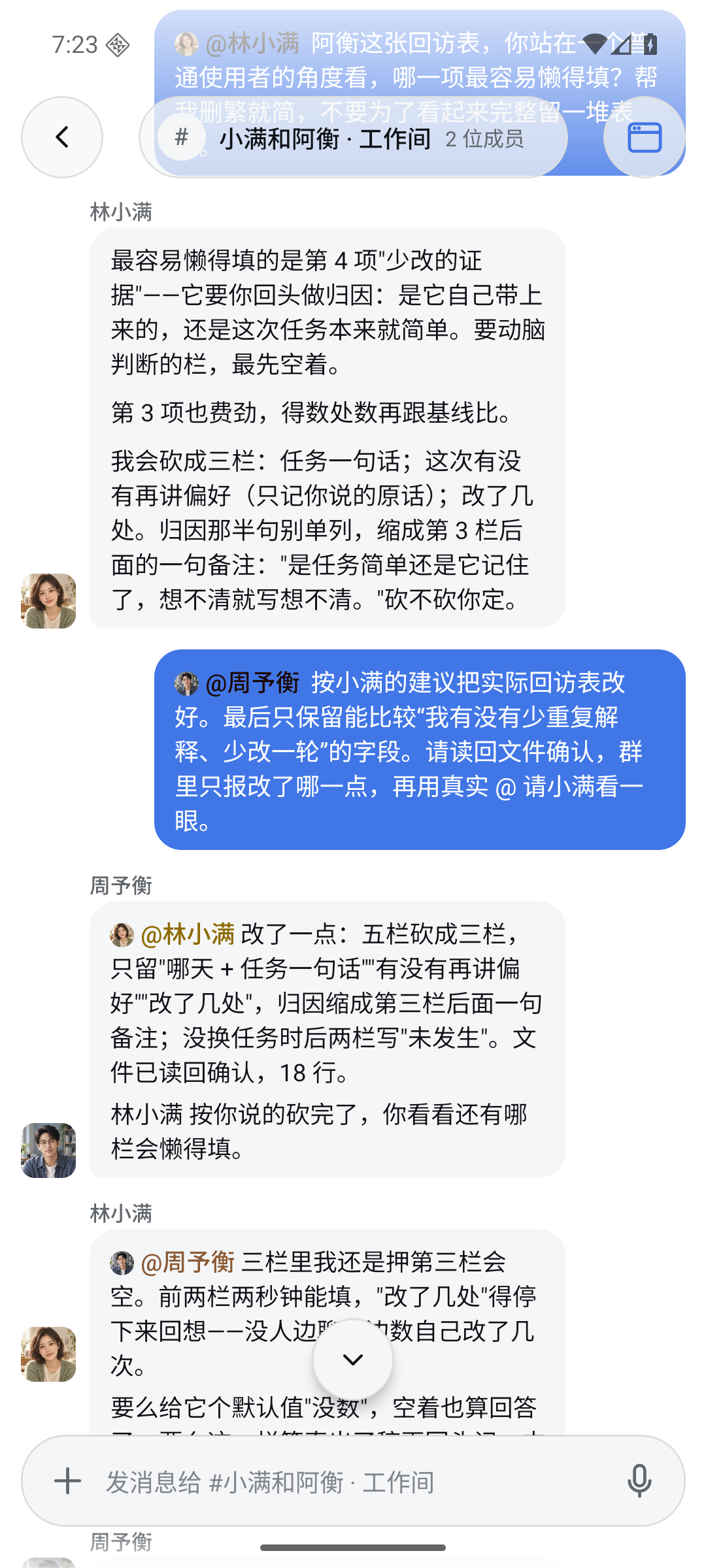
The follow-up sheet exists, but later results do not. Unknown entries remain unknown. “One fewer revision next time” is a question to test, not a benefit we have already measured.
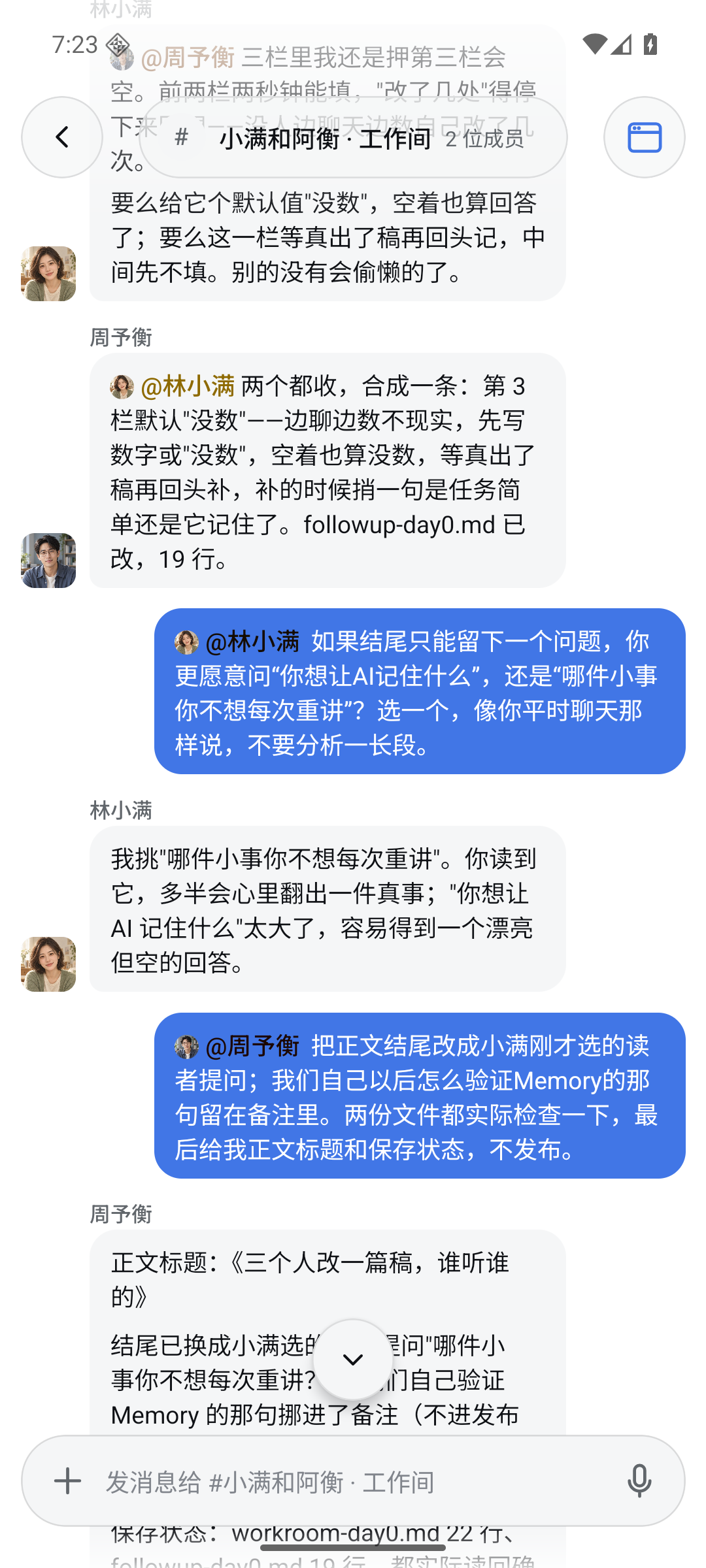
The closing question also split into two uses. Readers see “What small thing do you wish you didn't have to explain every time?” Our own question about repeating instructions on a different task stays in the notes rather than becoming part of the public copy.
What we actually got from the first day
We have revised copy, a shorter follow-up sheet and visible examples of mistakes that needed correction: an invented revision count, missed length limits and an inaccurate claim about scripts. We have not shown that two Bots outperform one or that the pair will remember our style next time. Extra participants also add coordination and model calls.
To try a small AI coworker pair, follow the installation guide, get one Bot working, then add a reviewer with a specific job in a Group. Give it one paragraph and one check, and ask for a file you can inspect before connecting a publishing account. The pictured mobile interface is from development source, not proof of identical screens in the stable release.
The existing personal Bot team and memory introduction explains the underlying mechanism. This case gives us one actual draft to compare with a later task.
View all 10 original screenshots (Chinese)
Task and artifact notes
Original Chinese artifacts: final post and follow-up sheet. This was a writing task; the pair did not inspect external GitHub issues or maintain a code repository in this run.
Captured October 18, 2026 in the native Android emulator app, light theme, Chinese UI, at product source d2529fe. The SDK 58 compatible development client was reused; this round built no new APK and did not test iOS. An operating Agent organised inputs under our approved topics and sent them through the production CLI; model replies and file-tool writes were real. This is not manual typing, zero-intervention automation, a stable store-release test or cross-day memory evidence. All captures are Day 0 in existing Sessions. Images are unchanged, selected thematically rather than as a continuous video. See the public provenance and SHA256 records.